When I say I'm weak for a good heist story, I mean weak. Ocean's Eleven, Locke Lamora, Holly Black's Curse Workers trilogy, The Sting, the list goes on. Give me a person (or, preferably, a group of people) robbing some rich asshole blind and having a snarky fantastic time while doing it, and I'll eat it up like candy.
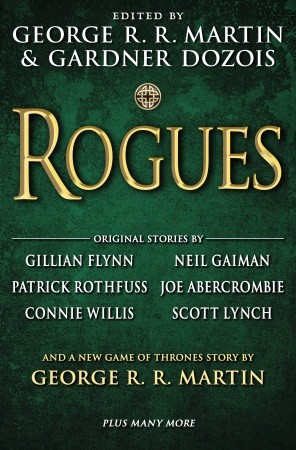
Greg Van Eekhout wrote a great blog last summer about the magic involved in a successful heist, and he's right-- there is something irresistible about that sleight-of-hand smile-at-me-while-my-partner-steals-your-wallet kind of character. As it turns out, George R. R. Martin feels the same way, and so he went about assembling a collection of stories all featuring rogues in one form or another. As with any anthology, this was a bit of a mixed bag, with some stories sticking more successfully to the theme than others. I've briefly reviewed each story in terms of its relevance to the theme, and its overall awesomeness, below the cut.
what started as a book review blog is morphing into a home for my musings on being a girl and being gay and the ways that intersects with my being a geek, and with geek culture. i do still and will continue to review books, because i read a lot and it's primarily what i enjoy talking about. if you've got a recommendation, or want to hear what i have to say on a topic, feel free to leave it in the comments.
Showing posts with label urban fantasy. Show all posts
22 January, 2015
30 September, 2013
An immortal wizard walks into the World Series of Poker... : "The Incrementalists" by Steven Brust and Skyler White
It sounds like the setup to a bad joke. A guy sits alone in a bar in Vegas, waiting for his next poker game to start. He flirts with the waitress, has a drink, thinks about the fact that his ex-girlfriend recently committed suicide; nothing really to set him apart from the sludge of humanity around him. But underneath his baseball cap sits a mind that's been reincarnated through dozens of bodies over the course of many centuries-- a mind that remembers every era of history and every time he used his magic to change things for the better. And the best part is, our wizard isn't alone. He's got 200 friends just like him-- a secret society who's been magically nudging people toward working for the greater good, operating between the lines since the dawn of time. This is the premise of Steven Brust and Skyler White's The Incrementalists-- the foundation for a story that is simultaneously fantastical and everyday, mixing magic both wondrous and mundane.
Labels:
★★★★,
2013,
review,
skyler white,
steven brust,
urban fantasy
29 July, 2013
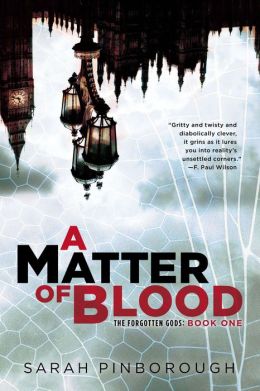
'A Matter of Blood' by Sarah Pinborough
The opening act of Sarah Pinborough's urban fantasy horror trilogy is dark. It's gory, it's harsh and unflinching in its descriptions of an ugly world; no romps with city-dwelling fairies here. It's urban fantasy at its most brutal, illuminating a bleak potential future where-- as our killer makes a habit of pointing out-- nothing is sacred. It's that idea of the sacrosanct that winds its way throughout the book, touching each of the characters in turn, leading the jaded Detective Jones to a thorough examination of not only the ways in which his society is broken, but in which he is as well.
Labels:
★★★★★,
2013,
dystopian future,
horror,
in a series,
review,
sarah pinborough,
urban fantasy
25 June, 2013
'Bronze Gods' by A. A. Aguirre
So,
in complete contrast to my reaction to Fade to Black,
Bronze Gods surprised me by how much I loved it. I won't say I didn't
expect to enjoy myself, because a crime fighting team in a steampunk
universe with magic sounds like bona fide enjoyment material in my
book. But I expected fluff-- a quick read, nothing heavy. I was
pleasantly surprised to discover instead a wholly engaging read with
characters that leapt off the page and a world I wanted to explore
every nook and cranny of.
Labels:
★★★★★,
2013,
a. a. aguirre,
mystery,
review,
steampunk,
urban fantasy,
women in fantasy
14 June, 2013
Fade to Black (Rojan Dizon #1) by Francis Knight
Holy funemployment, Batman, two in one week!
So I hope that whoever wrote the jacket copy for Fade to Black has their own publishing deal, because they did a great job. Based on a quick scan, the book sounded edgy, dangerous and exciting. It was featured on bn.com the week I bought my new nook, and I was SO close to paying for it... But, luckily for me, I borrowed it from a friend first. It turns out I would've been pretty mad had I shelled out money for it.
The book isn't terrible, and there are some aspects of it that are great-- okay, actually, I take that back, there is one aspect of it that is great, and that is the worldbuilding. The city felt real, the descriptions vivid even when they weren't overly verbose, and the atmosphere thick enough to taste. It's clear that Francis Knight put a lot of thought into her world, that she knows it well down to the small details. But it's useless to have a great world if you don't populate it with great characters, and in that Knight failed pretty spectacularly.
There are three main characters in the book-- the protagonist, bounty hunter and pain mage Rojan; the girl swordfighter Jake; and her best friend / would-be lover Pasha. Pasha is easily the most interesting of the three. He's a pain mage like Rojan, with a painful past-- he was sold into slavery to be used as fodder for another pain mage's power and endured years of constant abuse, all when he was mostly a kid. He's in love with Jake, but she's got the same past trauma that manifests in a deep aversion to being touched, therefore taking intimacy of any kind off the table. He sticks by her because it's their secret mission to find other people who've been sold to the mages (like Rojan's niece, which is what crosses his path with theirs) and get them to freedom. He's pretty badass and bold when it comes to acting on behalf of others, but emotionally passive when it comes to himself; a nice duality. He got flatter and more predictable as the book went on, but he was the only one who made me feel any real sympathy.
Jake has all the trappings of an interesting powerful female, but unfortunately she isn't any of those things. She's a statue on a pedestal to Rojan, not a person. Some reviewers have compared this construct to the archetypes found in classic noir, but that's not a comparison I can get behind. She's certainly no femme fatale, and while it seems Knight intended for her to play the part of the elusive ice queen who gets under the private eye's skin, she misses the mark. She doesn't need Rojan's help, so there's no give and take in their relationship, and she's so closed off emotionally that most of Rojan's response to her seemed to be based on physical attraction-- which is fine, but isn't a carrier for the intrigue and emotional desire Rojan claimed to feel for her.
But my real problem with Jake is that Knight had a great opportunity to paint the picture of a strong, independent woman who had overcome adversity to take control over her life, and didn't. Jake is a pit fighter, really strong and agile, and she's a subversive freedom fighter working behind the scenes to go against the rule of law. But in the moments I most wanted her to shine, she caved. Pasha kills a man so Jake doesn't have to (she's very proud of her no-kill record in the pits) and she drives him away, a disproportionate response that's clearly a device to get her and Rojan alone, and one that makes her look unreasonable and unstable.
Then, in spite of her explicitly stated aversion to touch, Rojan kisses her and she doesn't even fight back. Instead it's like an eye-opener-- oh, I really was fine with making out all this time, who knew? Probably pretty disturbing to read if you're a survivor of that kind of abuse. And the icing on the disappointment cake was that she never overcame her fear and got back at the man who enslaved her. Instead, another clumsy plot device had Rojan step in to do it for her. I liked Jake alright, but she didn't grab me either as a heroine or as a love interest, and in terms of the power and agency of women in the book she left a lot to be desired.
She got a really kick-ass entrance, though, I'll say that much.
And Rojan. Oh, Rojan. I can't decide if this is how the author thinks jaded and world-weary men actually think and talk, or if she personally knows someone who's simultaneously this misogynistic and this boring, but either way, he doesn't play well. He hovers in this limbo between actually being a womanizing sleazebag and only pretending to be one-- it's like the author wanted to make him unlikable and have a bad attitude towards women, but didn't have the stomach to take it all the way. He isn't like Barney Stinson or Han Solo-- I never once bought the image of Rojan as a cad who treats women like they're disposable because he's afraid of emotional intimacy. The book opens with him getting notes from the three women he's seeing who've all just found out about each other and trash his apartment for it, and he talks a lot-- incessantly-- about how bad he is at relationships, how much of a womanizer he is, etc. But we never meet any of the girlfriends, or even see first-hand what they do to his apartment, so there are no consequences for his jerk behavior. There's never even a hint of the fact that he might want something more out of relationships, just more casual contempt for the idea of them.
All this means that when Jake finally appears on the scene and Rojan suddenly starts spouting off about how much he likes her and how she makes him want to be a better man, the intended revelation falls extremely flat. Because Jake isn't as well rounded as I'd like, and certainly neither is Rojan, I didn't feel the supposed connection between them at all. The author kept talking about it, but it never grabbed me in the gut. Especially when contrasted with Mikani and Ritsuko in Bronze Gods (which I'll be reviewing next), who had chemistry and tension enough to drive me to drink, I felt like both Rojan and the author were just going through the motions of the typical transformative falling-in-love experience, rather than actually... well... experiencing it.
I didn't completely hate this book. It was a quick read and it wasn't the worst urban fantasy I've ever read. But it disappointed me so much in relation to my expectations that it left a sour taste in my mouth. Ultimately I wanted the author to delve into Rojan's actual weaknesses-- his fears, his self doubts, his shitty relationship with his brother (which is the only arena in which I really felt sympathy with him), his dead mother-- instead of having them all glossed over and then neatly tied up at the end. I'm not even sure how the author plans to make a sequel happen, since so many of the problems were resolved by the end of the book. Hopefully the next one won't give such token nods to Rojan's issues, and will have a supporting cast that's a lot more fleshed out. Unfortunately, unless it's recommended to me by someone I trust, I won't be taking the time to find out.
So I hope that whoever wrote the jacket copy for Fade to Black has their own publishing deal, because they did a great job. Based on a quick scan, the book sounded edgy, dangerous and exciting. It was featured on bn.com the week I bought my new nook, and I was SO close to paying for it... But, luckily for me, I borrowed it from a friend first. It turns out I would've been pretty mad had I shelled out money for it.
The book isn't terrible, and there are some aspects of it that are great-- okay, actually, I take that back, there is one aspect of it that is great, and that is the worldbuilding. The city felt real, the descriptions vivid even when they weren't overly verbose, and the atmosphere thick enough to taste. It's clear that Francis Knight put a lot of thought into her world, that she knows it well down to the small details. But it's useless to have a great world if you don't populate it with great characters, and in that Knight failed pretty spectacularly.
There are three main characters in the book-- the protagonist, bounty hunter and pain mage Rojan; the girl swordfighter Jake; and her best friend / would-be lover Pasha. Pasha is easily the most interesting of the three. He's a pain mage like Rojan, with a painful past-- he was sold into slavery to be used as fodder for another pain mage's power and endured years of constant abuse, all when he was mostly a kid. He's in love with Jake, but she's got the same past trauma that manifests in a deep aversion to being touched, therefore taking intimacy of any kind off the table. He sticks by her because it's their secret mission to find other people who've been sold to the mages (like Rojan's niece, which is what crosses his path with theirs) and get them to freedom. He's pretty badass and bold when it comes to acting on behalf of others, but emotionally passive when it comes to himself; a nice duality. He got flatter and more predictable as the book went on, but he was the only one who made me feel any real sympathy.
Jake has all the trappings of an interesting powerful female, but unfortunately she isn't any of those things. She's a statue on a pedestal to Rojan, not a person. Some reviewers have compared this construct to the archetypes found in classic noir, but that's not a comparison I can get behind. She's certainly no femme fatale, and while it seems Knight intended for her to play the part of the elusive ice queen who gets under the private eye's skin, she misses the mark. She doesn't need Rojan's help, so there's no give and take in their relationship, and she's so closed off emotionally that most of Rojan's response to her seemed to be based on physical attraction-- which is fine, but isn't a carrier for the intrigue and emotional desire Rojan claimed to feel for her.
But my real problem with Jake is that Knight had a great opportunity to paint the picture of a strong, independent woman who had overcome adversity to take control over her life, and didn't. Jake is a pit fighter, really strong and agile, and she's a subversive freedom fighter working behind the scenes to go against the rule of law. But in the moments I most wanted her to shine, she caved. Pasha kills a man so Jake doesn't have to (she's very proud of her no-kill record in the pits) and she drives him away, a disproportionate response that's clearly a device to get her and Rojan alone, and one that makes her look unreasonable and unstable.
Then, in spite of her explicitly stated aversion to touch, Rojan kisses her and she doesn't even fight back. Instead it's like an eye-opener-- oh, I really was fine with making out all this time, who knew? Probably pretty disturbing to read if you're a survivor of that kind of abuse. And the icing on the disappointment cake was that she never overcame her fear and got back at the man who enslaved her. Instead, another clumsy plot device had Rojan step in to do it for her. I liked Jake alright, but she didn't grab me either as a heroine or as a love interest, and in terms of the power and agency of women in the book she left a lot to be desired.
She got a really kick-ass entrance, though, I'll say that much.
And Rojan. Oh, Rojan. I can't decide if this is how the author thinks jaded and world-weary men actually think and talk, or if she personally knows someone who's simultaneously this misogynistic and this boring, but either way, he doesn't play well. He hovers in this limbo between actually being a womanizing sleazebag and only pretending to be one-- it's like the author wanted to make him unlikable and have a bad attitude towards women, but didn't have the stomach to take it all the way. He isn't like Barney Stinson or Han Solo-- I never once bought the image of Rojan as a cad who treats women like they're disposable because he's afraid of emotional intimacy. The book opens with him getting notes from the three women he's seeing who've all just found out about each other and trash his apartment for it, and he talks a lot-- incessantly-- about how bad he is at relationships, how much of a womanizer he is, etc. But we never meet any of the girlfriends, or even see first-hand what they do to his apartment, so there are no consequences for his jerk behavior. There's never even a hint of the fact that he might want something more out of relationships, just more casual contempt for the idea of them.
All this means that when Jake finally appears on the scene and Rojan suddenly starts spouting off about how much he likes her and how she makes him want to be a better man, the intended revelation falls extremely flat. Because Jake isn't as well rounded as I'd like, and certainly neither is Rojan, I didn't feel the supposed connection between them at all. The author kept talking about it, but it never grabbed me in the gut. Especially when contrasted with Mikani and Ritsuko in Bronze Gods (which I'll be reviewing next), who had chemistry and tension enough to drive me to drink, I felt like both Rojan and the author were just going through the motions of the typical transformative falling-in-love experience, rather than actually... well... experiencing it.
I didn't completely hate this book. It was a quick read and it wasn't the worst urban fantasy I've ever read. But it disappointed me so much in relation to my expectations that it left a sour taste in my mouth. Ultimately I wanted the author to delve into Rojan's actual weaknesses-- his fears, his self doubts, his shitty relationship with his brother (which is the only arena in which I really felt sympathy with him), his dead mother-- instead of having them all glossed over and then neatly tied up at the end. I'm not even sure how the author plans to make a sequel happen, since so many of the problems were resolved by the end of the book. Hopefully the next one won't give such token nods to Rojan's issues, and will have a supporting cast that's a lot more fleshed out. Unfortunately, unless it's recommended to me by someone I trust, I won't be taking the time to find out.
Labels:
★★,
2013,
francis knight,
review,
urban fantasy,
women in fantasy
05 March, 2013
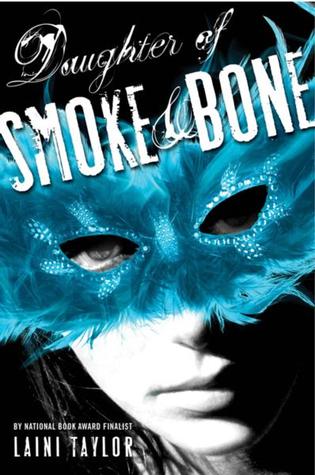
'Daughter of Smoke and Bone' by Laini Taylor
For my first review back from what was, admittedly, a hiatus that stretched the meaning of the word past its breaking point, I wanted to come back with a bang. And Daughter of Smoke and Bone is nothing if not full of bang.
10 February, 2012
'Hounded', 'Hexed' and 'Hammered' by Kevin Hearne
Normally I would split these books up into three posts, one review for each. But they fit together so seamlessly that it felt like one long book-- one long, action packed, deeply awesome book-- so I'm going to review them all together.
Let me start by saying that I downloaded these books onto my Nook on a whim. A friend of mine had praised them highly on her Goodreads page, and I thought hey, why not. It was a wise move; once I started I was hooked. The trilogy stars Atticus O'Sullivan, the last Druid on Earth, who looks like a twenty-year-old college kid but is really over two thousand years old. He's living under cover, owning and managing an occult bookstore/tea shop combo in Arizona, hanging out with an old Irish widow who lives nearby, flirting with the cute bartender at the local pub. On the surface it seems like he's living a totally normal life. Except for the part where he gets visited by the Irish goddess of Death, his lawyer is a Viking vampire who accepts payment in goblets of blood, and oh yeah, his dog can talk to him-- in his mind.
Labels:
★★★★,
2012,
fantasy,
kevin hearne,
mythology,
religion,
review,
urban fantasy,
women in fantasy
26 January, 2012
'Sweetly' by Jackson Pearce
Like its predecessor Sisters Red, Sweetly is a story we know inside and out, modernized and retold. Jackson Pearce has taken a classic fairy tale-- in this case, Hansel and Gretel-- and cut it open, messed around with its insides, and sewn it back up again. The story looks the same, and the bones of it haven't changed, but almost everything else about it has-- in my opinion, for the better.
11 January, 2012
'Bloodsucking Fiends' by Christopher Moore
Happy New Year, everyone!
So I said I was going to review "Treasure Island!!!" by Sara Levine, but I changed my mind. It was a fast and funny read, but the more I write these reviews the more I feel compelled to focus this blog on sci-fi and fantasy books, of which Levine's was not one. It was funny, but painfully so, a bit like if Kimmy Gibler had a cameo on an episode of Arrested Development : awkward and ridiculous, each interchange leaving me unsure if I was supposed to laugh or cringe, or both. I liked it, but it didn't wow me. (Sidebar-- the fact that most, if not all, kids who are graduating from high school this year have no idea who Kimmy Gibler is, is a tragedy of epic proportions. Discuss in comments.)
Moving on: I picked up Bloodsucking Fiends at last, after it sat on my shelf for almost a year, staring me down. I was expecting a quick read with a lot of laughs, and I wasn't disappointed. But I wasn't expecting the commentary, the intelligence in the humor, or how the book turned the romanticizing of vampires on its ear.
So I said I was going to review "Treasure Island!!!" by Sara Levine, but I changed my mind. It was a fast and funny read, but the more I write these reviews the more I feel compelled to focus this blog on sci-fi and fantasy books, of which Levine's was not one. It was funny, but painfully so, a bit like if Kimmy Gibler had a cameo on an episode of Arrested Development : awkward and ridiculous, each interchange leaving me unsure if I was supposed to laugh or cringe, or both. I liked it, but it didn't wow me. (Sidebar-- the fact that most, if not all, kids who are graduating from high school this year have no idea who Kimmy Gibler is, is a tragedy of epic proportions. Discuss in comments.)
Moving on: I picked up Bloodsucking Fiends at last, after it sat on my shelf for almost a year, staring me down. I was expecting a quick read with a lot of laughs, and I wasn't disappointed. But I wasn't expecting the commentary, the intelligence in the humor, or how the book turned the romanticizing of vampires on its ear.
Labels:
★★★,
2012,
christopher moore,
review,
urban fantasy,
vampires,
women in fantasy
03 December, 2011
'Sisters Red' by Jackson Pearce
'Sisters Red' first caught my eye in the bookstore because of the awesome cover. I love YA, I love adapted fairy tales, and I love the growing population of badass teenage girls in YA fiction these days. This modernization of the Little Red Riding Hood story has all of these elements, plus a certain something to it that made me really enjoy it despite its flaws.
Labels:
★★★,
2011,
fairy tales,
family ties,
female protagonist,
jackson pearce,
review,
urban fantasy,
werewolves,
women in YA,
young adult
25 January, 2011
hark, a book review!
Wow, so I've really made good use of this, huh? >.>;;; In my defense, shortly after I created it, I got promoted at work, and that was basically the past six months done and gone. Oh retail Christmas, how I love to hate you.
Anyway, I thought I'd ring in 2011 by actually using this thing a bit. And to start I'm reviewing what turned out to be one of my favorite books of 2010, China Mieville's Kraken. Let me preface this by saying I am a huge Mieville fan; at this point I don't think he could write a book I wouldn't give five stars to. I even had to go back and add a star to my review of The City & The City because even weeks after I'd finished it I just could not stop thinking about it. And this, now, this little piece of genius has pretty much cemented him as my favorite author. I would write him fan mail if it wouldn't be epically creepy to do so.
Anyway-- an actual review of the book. Kraken begins with an impossible theft, that of the preserved giant squid from inside London's Natural History Museum, and its discovery by a very average, slightly nerdy scientist who works there. Billy Harrow is a wonderful protagonist-- one of the genius aspects of Mieville's writing is that his characters always feel like they might be you or someone you know-- and his descent from his very average life into a hidden city of cults and magic is immediately gripping because of the way the writing pulls you along every step of the way. You're experiencing everything with Billy-- the wonder, the fear, trying to reason out what's happening, rejecting the rules and deciding to do his own thing-- until you are in as deeply over your head as he is. And then along comes Dane. If Billy is the embodiment of everything familiar, Dane is the exact opposite: a holy assassin playing security guard, a man on fire with faith and devotion to a god most would call him insane to worship, a self-made exile from everything he holds dear for the sake of protecting the man he believes can save it. Everything about him is strange at first, but as Billy goes further and further into Dane's world, he comes to see his new protector as not only familiar but safe. And then, as a team, as partners, they dive all the way down the rabbit hole and try to save the world.
This book, like all of Mieville's, is astonishing in its complexity. The amount of work that had to have gone into plotting this thing out-- imagining all the cults, the creatures, the characters that are all intricate and complete entities even if their totality is only hinted at-- it boggles the mind. Chaos Nazis! Living tattoos! Tribbles and phasers that actually work! And characters like Wati, formerly a spirit buried with an Egyptian pharaoh to serve him in the afterlife, now the socialist strike leader for all the familiars of London. Like Goss and Subby, a pair of Croup-and-Vandemar-esque assassins who meander around the book bumping off the good guys with excruciating enjoyment. And Kath Collingswood, who really defies description but is one of the best characters I've had the pleasure of encountering in the pages of urban fantasy. But part of what really makes the book come to life is how London itself feels like a character. Certainly it's living and breathing to the characters that populate it, and under Mieville's loving pen it comes alive even for me, who's never seen it except in books and pictures.
Kraken combines the best of Neverwhere with the best of American Gods, adds in as many chases and fight scenes and displays of badassery my action-movie-loving heart could desire, along with a dash of grotesquerie and a healthy helping of Mieville's characteristic New Weird. The result is a wild and unpredictable ride that gathers momentum and doesn't come to rest until after its heart-stopping climax. I loved it beyond words-- despite the fact that I've just used several hundred to describe how much-- and if you pick it up, don't be surprised if it keeps you held tight in its tentacles until you've turned the last page.
Anyway, I thought I'd ring in 2011 by actually using this thing a bit. And to start I'm reviewing what turned out to be one of my favorite books of 2010, China Mieville's Kraken. Let me preface this by saying I am a huge Mieville fan; at this point I don't think he could write a book I wouldn't give five stars to. I even had to go back and add a star to my review of The City & The City because even weeks after I'd finished it I just could not stop thinking about it. And this, now, this little piece of genius has pretty much cemented him as my favorite author. I would write him fan mail if it wouldn't be epically creepy to do so.
Anyway-- an actual review of the book. Kraken begins with an impossible theft, that of the preserved giant squid from inside London's Natural History Museum, and its discovery by a very average, slightly nerdy scientist who works there. Billy Harrow is a wonderful protagonist-- one of the genius aspects of Mieville's writing is that his characters always feel like they might be you or someone you know-- and his descent from his very average life into a hidden city of cults and magic is immediately gripping because of the way the writing pulls you along every step of the way. You're experiencing everything with Billy-- the wonder, the fear, trying to reason out what's happening, rejecting the rules and deciding to do his own thing-- until you are in as deeply over your head as he is. And then along comes Dane. If Billy is the embodiment of everything familiar, Dane is the exact opposite: a holy assassin playing security guard, a man on fire with faith and devotion to a god most would call him insane to worship, a self-made exile from everything he holds dear for the sake of protecting the man he believes can save it. Everything about him is strange at first, but as Billy goes further and further into Dane's world, he comes to see his new protector as not only familiar but safe. And then, as a team, as partners, they dive all the way down the rabbit hole and try to save the world.
This book, like all of Mieville's, is astonishing in its complexity. The amount of work that had to have gone into plotting this thing out-- imagining all the cults, the creatures, the characters that are all intricate and complete entities even if their totality is only hinted at-- it boggles the mind. Chaos Nazis! Living tattoos! Tribbles and phasers that actually work! And characters like Wati, formerly a spirit buried with an Egyptian pharaoh to serve him in the afterlife, now the socialist strike leader for all the familiars of London. Like Goss and Subby, a pair of Croup-and-Vandemar-esque assassins who meander around the book bumping off the good guys with excruciating enjoyment. And Kath Collingswood, who really defies description but is one of the best characters I've had the pleasure of encountering in the pages of urban fantasy. But part of what really makes the book come to life is how London itself feels like a character. Certainly it's living and breathing to the characters that populate it, and under Mieville's loving pen it comes alive even for me, who's never seen it except in books and pictures.
Kraken combines the best of Neverwhere with the best of American Gods, adds in as many chases and fight scenes and displays of badassery my action-movie-loving heart could desire, along with a dash of grotesquerie and a healthy helping of Mieville's characteristic New Weird. The result is a wild and unpredictable ride that gathers momentum and doesn't come to rest until after its heart-stopping climax. I loved it beyond words-- despite the fact that I've just used several hundred to describe how much-- and if you pick it up, don't be surprised if it keeps you held tight in its tentacles until you've turned the last page.
Labels:
★★★★★,
2010,
china mieville,
fantasy,
religion,
review,
urban fantasy
Subscribe to:
Posts (Atom)